
Byzantine games
Internecine tension between Turkey and Greece plays out over some of Istanbul's greatest treasures

It’s been nearly 5 years since I’ve been inside two of my favorite edifices in Istanbul. But it’s not out of lack of time or curiosity. I just don’t think my heart can handle the pain of what I’ll see. I’m talking about the almighty Hagia Sophia and the smaller but heart-breakingly gorgeous Kariye or Chora Church. Both are some of the greatest remaining treasures the world has from the long-gone Byzantine era, and both have become, in recent years, pawns in regional power games that carry implications for everyone.
The history of Hagia Sophia stretches back of course to almost 2 thousand years; its foundations date to Emperor Justinian, who ruled Byzantium from 527-567 AD during some of its most instrumental years, after Christianity had taken official root in 325AD, following the First Council of Nicaea. Justinian oversaw the construction of this monumental rose-colored edifice between 532-537 AD; when it was completed, it not only had the largest dome in the world, but was also the largest indoor space in the world, an incredible concept in and of itself I think! The Hagia Sophia wasn’t surpassed in size by anything until the Cathedral of Seville was built, in 1520, which meant that it stood sui generis in the world for around 1,000 years. When Constantinople was finally invaded in 1453 by the Ottomans, led by Fatih Sultan Mehmet, the Hagia Sophia was converted to a mosque. It remained that way until 1931, by which time the Ottoman Empire had collapsed, with the modern secular Turkish Republic on the move. And then, in 1931, Ataturk declared the Hagia Sophia should be reopened as a museum. And remain as a museum it did, until July 2020, when Turkey’s current president, Recep Tayyip Erdogan, declared it would return to its Ottoman roots (but *only* as far as its Ottoman ones, certainly not all the way back to its Byzantine ones!) and reopen as a mosque.
Similar to the trajectory of the Hagia Sophia, the smaller but even more mosaic-filled Chora Church (known popularly by some as “Saint Savior’s in the Fields”, the “fields” being a reference to its name “Chora” which in Greek denoted it as lying in open land, because at one point, it lay outside the city walls of Constantinople) also traces its roots back to the early Byzantine era (first foundations date to around the 4th century, when it was part of a monastery). But unlike the Hagia Sophia, it is a smaller, very typically Byzantine piece of architecture, and most significantly, possesses what are undoubtedly some of the finest displays of late Byzantine mosaic and fresco work in the world. Like the Hagia Sophia, the Chora Church was also turned into a mosque some years after the 1453 Ottoman conquest of Constantinople by the Turks. And again like the Hagia Sophia although a decade or so later, the Chora Church was also declared a museum during the early years of the Turkish Republic. So when Erdogan made a presidential decree, in August of 2020, that Chora (known in Turkish as “Kariye”) would now open as a mosque, it somehow seemed fitting and even inevitable, that its status would move in lockstep with one of the other Byzantine greats. Following this declaration, Chora was shut down for renovations, and has only just opened this year, in May 2024, for prayers.
So where does that leave us now? This little piece isn’t meant to be a hit job against Erdogan and the AK Party; that’s too simple. But the entire drama involving these two buildings is a true mirror that reflects back to us the binding sway of religion over politics in this area of the world, and maybe even more, the sway of the past over the present. When museums get converted back into mosques, it somehow starts to feel as though the Ottoman conquest of Constantinople was 50 years ago, not 500. It also feels like the enmities between the Byzantine Orthodox world and the Turkish Muslim world have never been and never will be buried, and that while they subsided for awhile, the scab has been ripped off the olds wounds. Perhaps one factor keeping those enmities fresh in people’s minds is that the spiritual center of the Eastern Orthodox world *still* lies in Istanbul, in the the Saint George Church in Fener, the seat of the Greek Patriarchate. Yes, even though the city has long ago transitioned from being Constantinople to being Istanbul, the Ecumenical Patriarch of Constantinople, Bartholomew (who has been Patriarch now since 1991), is still seen as the primus inter pares (“first among equals) of the some 300 million eastern Orthodox church followers in the world. This, in turn, seems to drive Erdogan just a little bit crazy. Which is why taking over the Hagia Sophia and the Chora Church, and turning them into much un-needed mosques (Istanbul is estimated to have around 3,000 mosques already), seems like a horrible bit of teasing which has caused damages that will take years and years to undo.
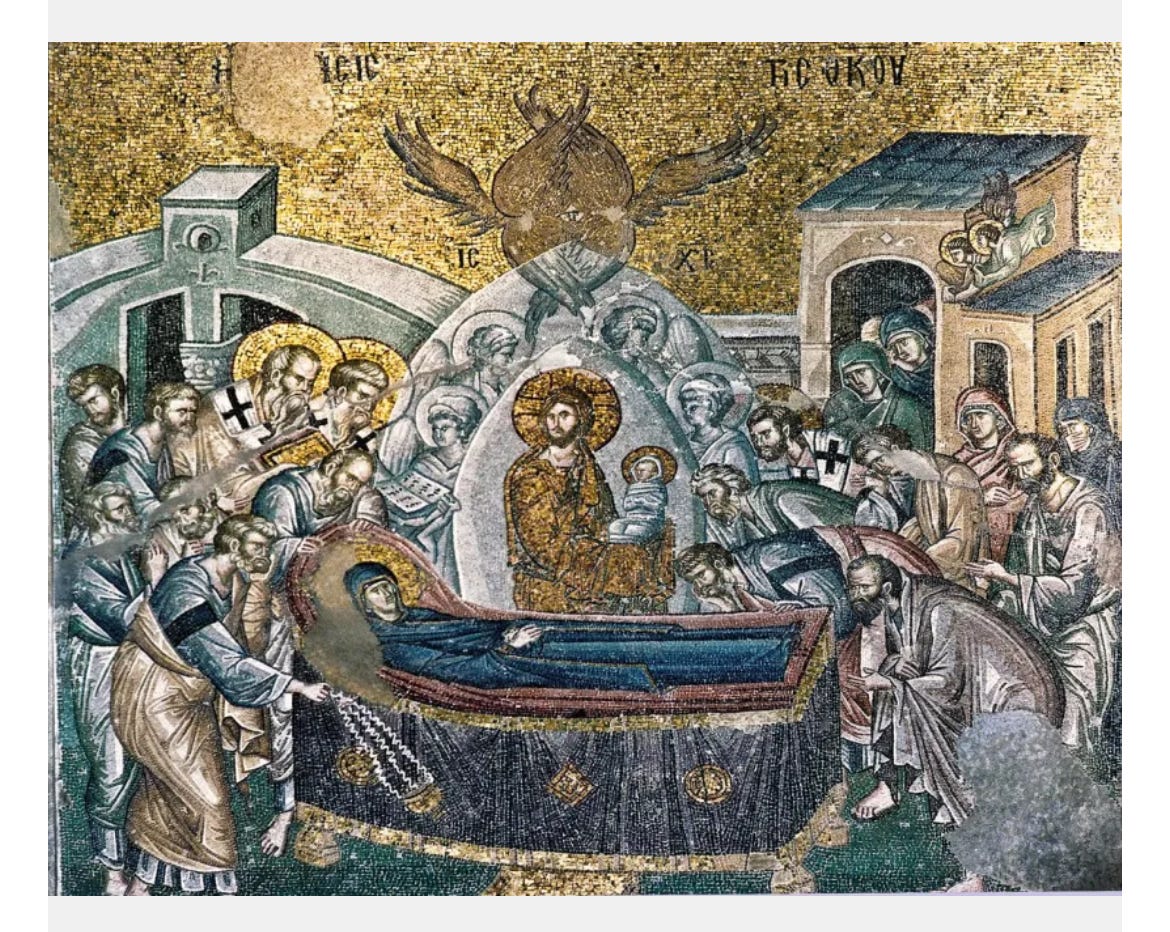
Personally, I’m scheduled to go see Chora in its new (old) iteration as a mosque in a couple of weeks. I cross my fingers that the mosaic I find most beautiful, which depicts the Dormition of Mary (she lies in her funeral bier, surrounded by apostles, with the heavenly Jesus as a grown male figure cradling her in his arms as a baby, a depiction of how her soul has returned to its purest, first life form) is not concealed by a sheet when I go in. I cross my fingers that no damage has been done to the frescoes and mosaics by the attendance of many more people now than the museum form of this 4th century edifice used to attract. When it comes to the Hagia Sophia though, I wait. I wait until Erdogan and the long shadows cast by his demagoguery have passed, until the masses have come to their senses, and until the internecine games and tensions of this region have receded a bit so that we can all enjoy some normalcy. One small and humbling realization: in the end, while the golds and greens of the ancient eastern Roman empire may be long gone, things actually *do* retain an all too byzantine nature around here. Maybe it’s something in the water?
Wonderful and tragic bit of history. Great writing.
excellent piece of research and writing. But it is your cri de coeur which is most poignant.